All Activity
- Past hour
-
 eo88casino changed their profile photo
 -
 Святослав Станкевич changed their profile photo
 - Today
-
 gg88gurucocom joined the community
 -
@Zenith432 Try clear NVRAM before booting in the preboot Volume
-
.thumb.png.393641bacb14c7ed03619f8789aad88d.png) Symphony Fountains joined the community
Symphony Fountains joined the community -
 Siberian Wellness joined the community
 -
 Md Limon joined the community
 -
@LuckyOldMan, Unfortunately, I don't have access to my Hackintosh at the moment because my NVMe drive failed (it burned out). In any case, please send me your EFI folder so I can check what might be causing the issue.
-
I used softwareupdate on Mac mini to download macos 15.7.7 and created a USB stick (which is new) with createinstallmedia. You think this can go bad? I can redo it. I just think if there were corrupted files there it would crash in a less subtle way. I could try to do the install on a mac mini to the external USB magnetic drive and see if that succeeds. 🤔
-
It could be a bad macOS Installer
-
Thanks. I'll try this later. Here's an update. The problem is not a faulty SSD. I tried (with my initial config) on an external USB magnetic drive with a 120 GiB APFS partition and ended up with exactly the same result. The time countdown during the 2nd stage actually went to down to 1 minute before reboot. Here's a little more detail of what I see I start out with a formatted APFS partition (newfs_apfs -C) and add one volume MacHD on it. Owners are enabled. After 1st stage install, there is still only one volume MacHD with one folder on it 'macOS Install Data'. It appears to contain everything (about 17.48GB). I can find no log. The APFS partition also has the Preboot, Recovery and VM volumes. After 2nd stage install, there are now two volumes. MacHD and "MacHD - Data". The one named MacHD is 11GB+ big and appears to have pretty much everything on it, maybe even too much (see later). The Data volume is nearly empty (about 312MB), with only one non-empty folder on it com.apple.installer that has most of the boot files of a recovery boot partition. It has a prelinked kernel, but no file named boot.efi (although there are boot.efi with various extensions.) What should be the Data volume can be found on the MacHD volume under System/Library/Templates/Data. It's not really a deployed Data volume, but some kind of template to be made into a Data volume. So this is something that looks like it should have been copied to the Data volume and 'filled in' from a template, then removed from the MacHD volume. But none of this got done. It's as if the installer decided to quit midway for some reason. There's a boot.efi in /usr/standalone/i386 under MacHD, but no com.apple.Boot.plist except in the right place under System/Library/Templates/Data where it's just a template without entries filled in. I couldn't find anything which may be a log of what happened during the 2nd stage. 😳
-
eo88casino joined the community
-
 HD Microns Limited joined the community
 -
010phbetnet1 joined the community
-
 Shanam Quà Tâm joined the community
 -
jepabo joined the community
-
 Mohammad Abdul joined the community
 -
 thethaoaggie changed their profile photo
 -
 Thanks for sharing your experience on the E6430! I totally get why you stayed on 10.11.6 — Fermi + Web Drivers on 10.13.6 is notoriously glitchy, and without OCLP back then there was no real fallback. But here's my actual goal: I'm not just considering 10.13.6 — I'm actually trying to push all the way to macOS Ventura 13.7.8. The reason is simple: even 10.13, 10.14, and other 10.x versions are now far too old. Many modern apps (browsers, dev tools, AI, Steam, etc.) have already dropped support for the entire 10.x line. Staying on any 10.x system means I'd still be stuck with outdated, insecure, or partially broken software. Ventura is the oldest macOS version that still gets relatively broader third-party app support compared to the 10.x era. I know Fermi (GT 555M) has zero native acceleration on Ventura and it'll be a framebuffer-only / basic display setup, but my priority is app compatibility rather than graphics performance. That's why I'm exploring DSDT patching, and OpenCore workarounds to make Ventura boot on this L702X 3D machine at all. Did you ever consider going beyond 10.13.6 toward something like Big Sur or Ventura just for the app ecosystem, despite the lack of GPU acceleration?
 -
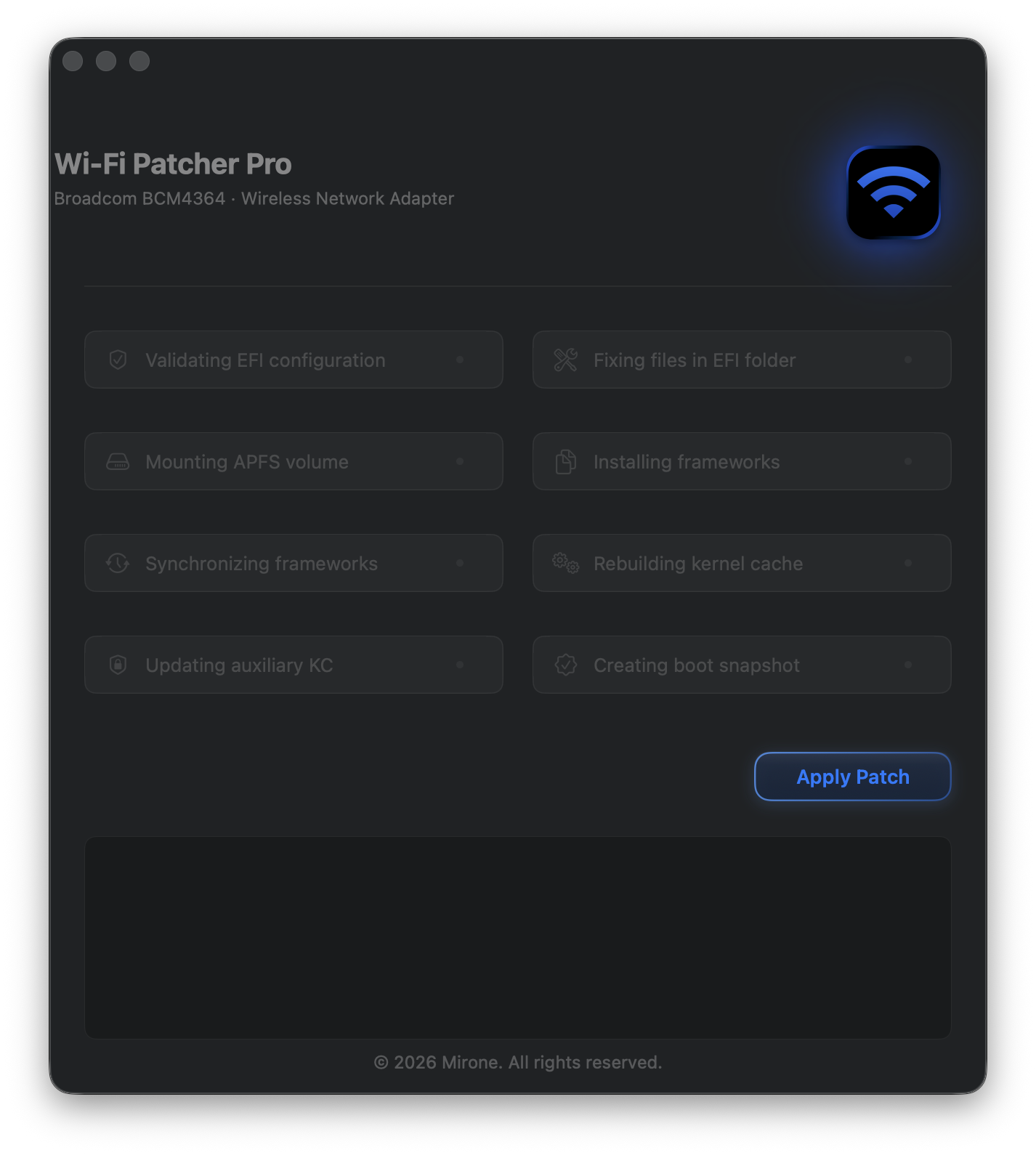
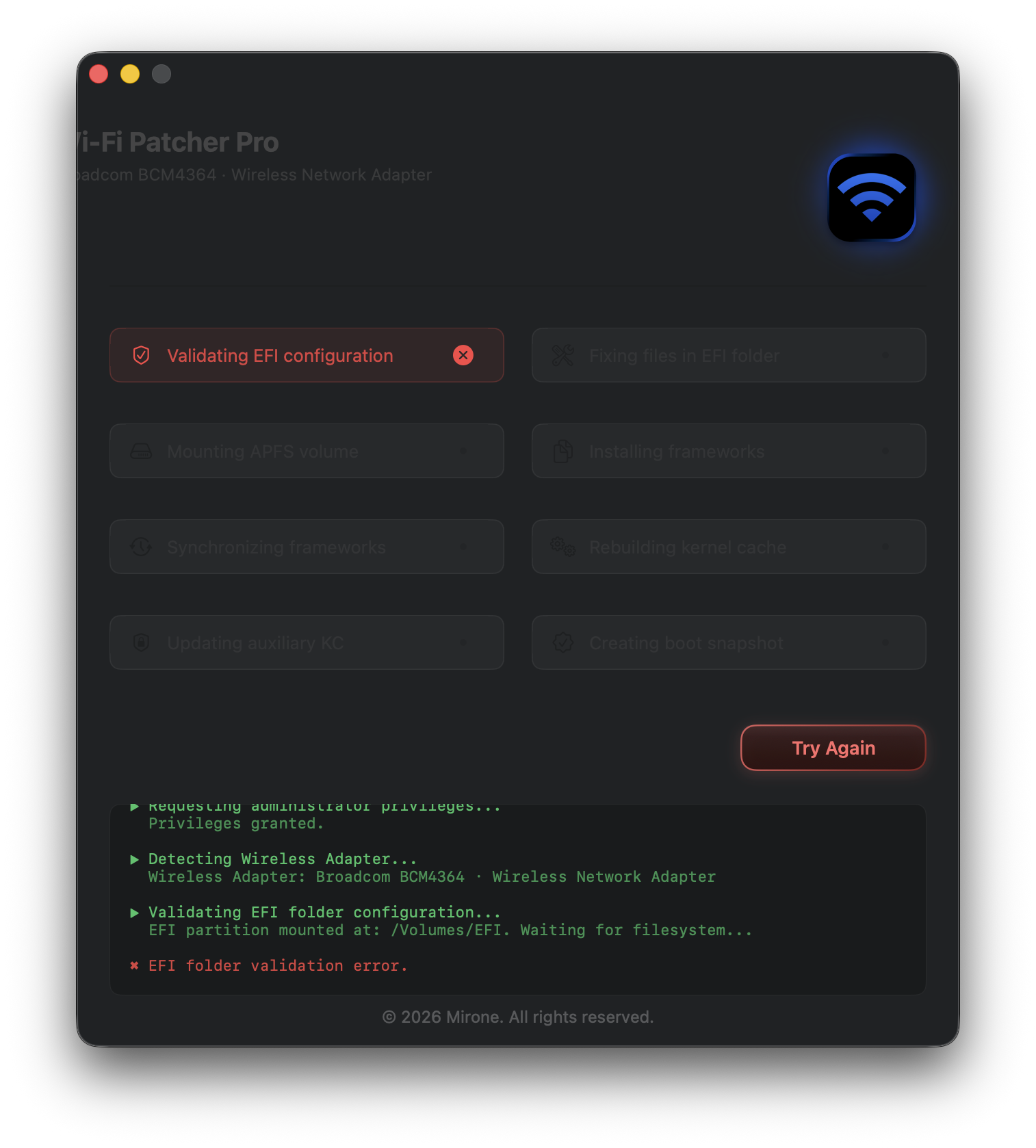
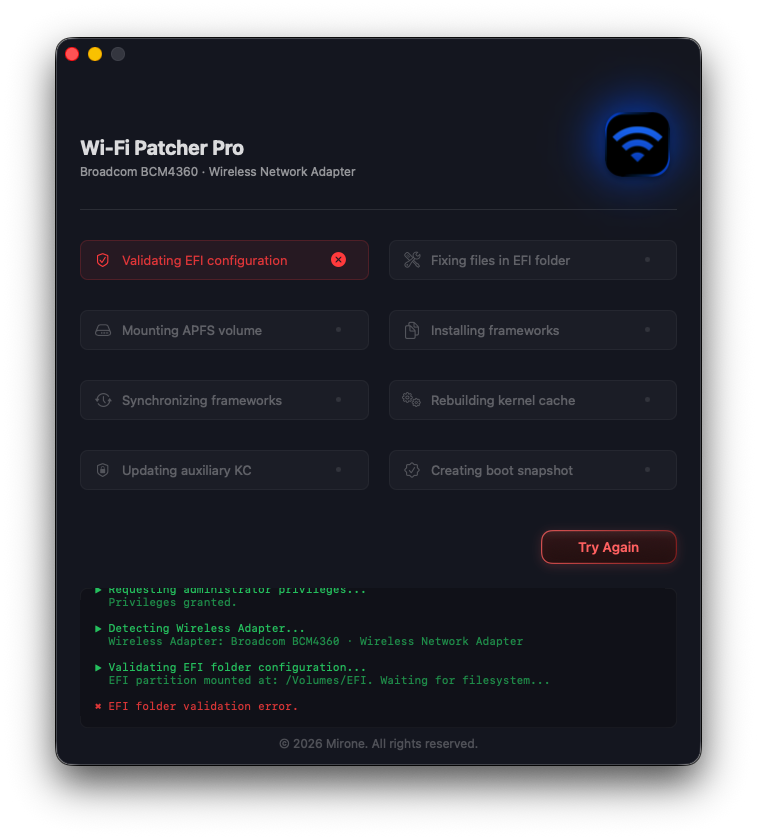
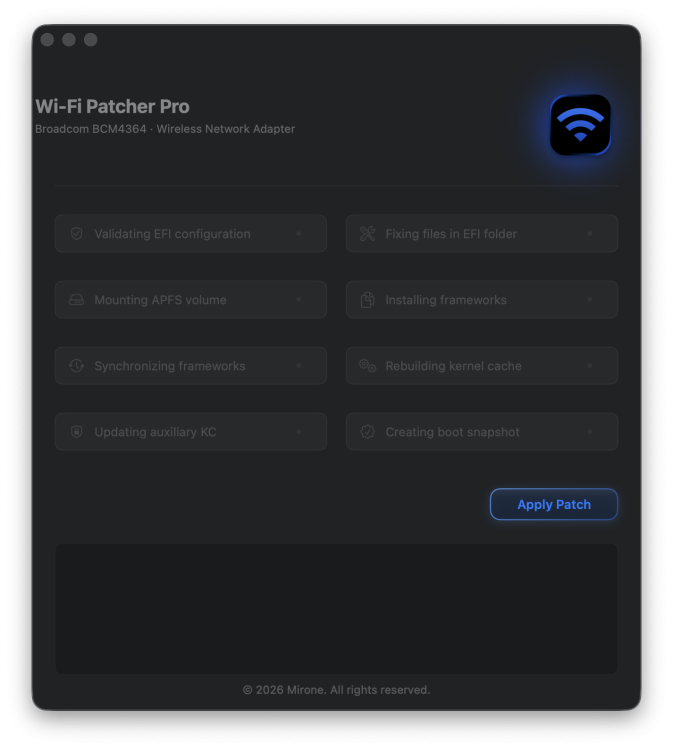
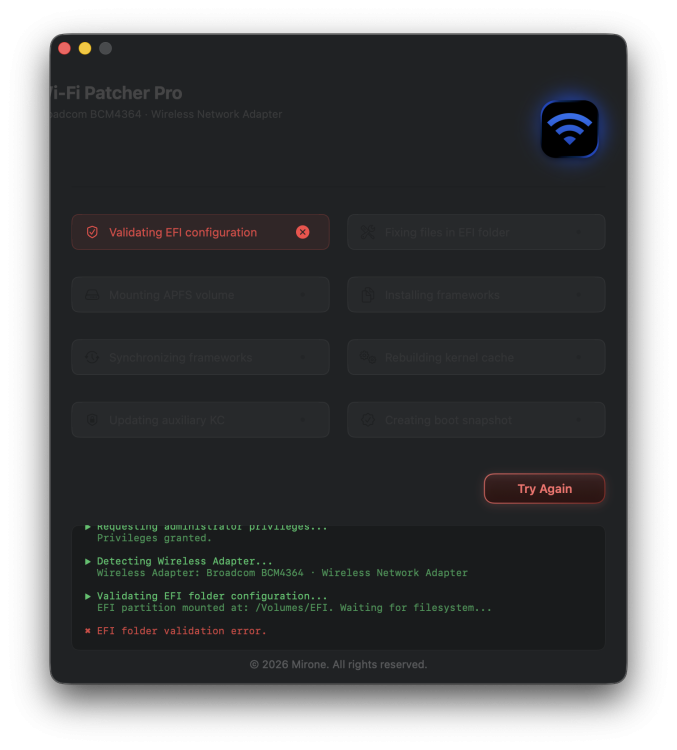
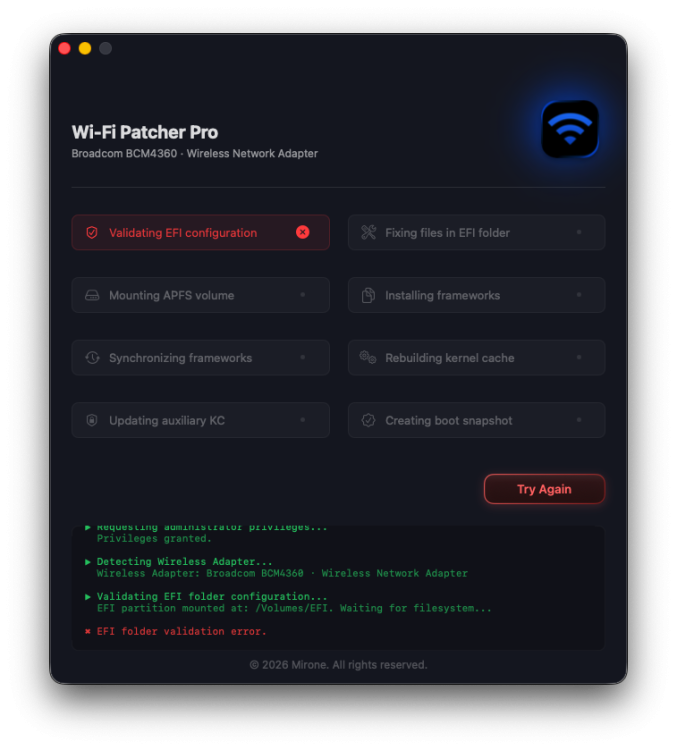
Last week I tried installing WiFi Patcher PRO – once on an iMac 18.3 @ Tahoe 26.5.2 @ OCLP3.0.0n and once on a Hackintosh MP7.1 @ Tahoe 26.5.2 @ OC 1.7. Unfortunately, without success. iMac 18.3: Hackintosh MP7.1 - Z170DL Both attempts ended with an "EFI folder validation error". What is going wrong?
-
 maniseo changed their profile photo
 -
.thumb.png.0dc09c21dc71cb6fd0ce5ac5f8100f16.png) thietkewebsitedanang changed their profile photo
thietkewebsitedanang changed their profile photo -
@naquaada I get why you're using Yosemite on your old Mac. What's not clear is why you're using OCLP with Yosemite on a real Mac. It seems that we're not understanding each other. Sorry I'm making this harder than it should be. I hope you find the cause and the solution.
-
 elite2222betcom changed their profile photo
 -
@lorys89 b10 version works fine on my M4. I think that all is as it should be. Good work.
-
 Pella Nova changed their profile photo
 -
Because it is the last version with the good Disk Utility. This one allows much better control, especcially if you are often using DIsk Images. And Yosemite is really fast. The boot process has none of the usual pauses in the loading bar, it boots right through in just 9 seconds. And because all software I use is available for Yosemite, it is for me a full operating system. I also have some 32-bit programs which I still use.
-
Hi @Zenith432 Happy to see you again 😀 Try this config attaching here, its yours but with the SMBIOS more completed You can clear the NVRAM first before booting to the USB install media config.plist.zip
- 31029 replies
-
- 1
-

-
- bootloader
- efi
- (and 2 more)
-
This: MACOSX_DEPLOYMENT_TARGET = 10.13
-
 IN 1.1.4 - Automatic updates — install & relaunch is now fully reliable: the app quits cleanly past the update dialog and relaunches itself into the new version. If it can't write to its own location it falls back to opening the download page instead. - Reliability fixes across the updater. Download: https://github.com/luminadevapps/KernelInspector/releases/download/v1.1.4/KernelInspector-1.1.4.dmg
 -
@Max.1974 You can run the sensor check—which takes 6 minutes—and then send me the file generated on the desktop. I'm missing the one for your M4 Pro CPU, so I can check if it's okay or if I need to tweak anything. Thanks, buddy.
-
 Vermeercamera changed their profile photo
 -
Google search shows "Memory try it!" is only on MSI motherboards and this is Gigabyte. There is no such feature in the BIOS. The "Above 4Gb encoding" is disabled and always has been. Nothing is overclocked. I took out a 2nd memory module that is slower and has dual rank, although I had the same install issue before putting it in. The module was causing delays during BIOS post for some reason anyway. I'll try install again when I have time and also try with an external magnetic hard drive. There's a problem with external drives that they have "Owners enabled" off by default and this sometimes casues security problems. For example I found that when doing TimeMachine restore of Catalina to an external drive, it restores the System Data volume with "Owners disabled" and the system won't boot unless the ownership is manually corrected with a script !!! I will try the OpenCore memory quirks although I don't know what they do. I will try looking for remnants of installation log files on the unworking system that ends up from install too. Thanks.
-
 thethaomp3 changed their profile photo
 -

[pre-release] macOS Tahoe 26.6
Thebes Knossos replied to strangeron's topic in New Releases and Updates
Here I had open a similar thread , not so complete : -
 followhireindia changed their profile photo
 -
Hello @Zenith432, long time to see you! I will be glad to help you if I can. First of all check your BIOS settings. One user found "Memory try it!" which resolved a similar problem. Also "Above 4Gb encoding" has very strange effects. Also look Quirks, especially about memory. Default values are not always right.
- 31029 replies
-
- 3
-
-
- bootloader
- efi
- (and 2 more)
-

Long-time lurker returning – Dell XPS 17 L702X 3D and XPS 9560 owner
Slice replied to Allen Cai's topic in New Users Lounge
I had Dell Latitude E6430 with Nvidia Fermi graphics chip. Yes, I disabled Intel GPU in BIOS and had full working 10.11.6 ElCapitan. In Sierra there are some glitches even with Web Drivers, somehow black desktop with good windows. There was no OCLP in that time. Good luck with your wishes to make higher macOS possible! -
Somehow VoodooHDA may work even in 10.9. In my old computer it works with ATI HD5570 in 10.11.6. So the MinimalSystemVersion is under question.
-
Thanks my friend ! 🤩👊🏻
-
Im with you Deveedee, though im still on 14.8.7 (23J520) on HP Prodesk 400 G3, havent gone into .8
-
Hey everyone, if you find the Finder's corner radius abit too much curvy, and want to have the sequioa border aesthetics, I made a tutorial how to make it look like on sequioa and remove the floating sidebar too. Link below https://youtu.be/EZkUZCCeqV0
-
Actually, the GT 555M is based on the NVIDIA Fermi architecture. The last macOS version to natively support Fermi GPUs with full Metal acceleration is macOS High Sierra (10.13.6), along with the final NVIDIA Web Drivers. Starting from macOS Mojave (10.14), native Fermi support was completely dropped. While it is technically possible to run newer systems using OpenCore Legacy Patcher (OCLP) to apply root patches, Fermi cards are classified as non-Metal GPUs. This means you only get extremely basic framebuffer output without any hardware graphics acceleration.
-
Yes, exactly. Since this is the 3D variant, the Intel HD 3000 is disabled at the BIOS/mux level, and the 120Hz panel is hard-wired directly to the NVIDIA GT 555M. There is no Optimus switching involved—it's a discrete-only setup. That's precisely why I'm looking into modifying the EFI/BIOS and DSDT to handle the display initialization properly under macOS Ventura.
-
Thanks for the clarification regarding the 5‑post rule. I’ll continue the discussion here until I’m cleared to post elsewhere. I’ve updated my signature with my hardware details. Here is the full breakdown for clarity: Laptop: Dell XPS L702X 3D CPU: Intel Core i7‑2820QM (2.3 GHz, Turbo up to 3.4 GHz) GPU: NVIDIA GeForce GT 555M (3 GB DDR3, Fermi, Device ID 10DE‑0DCD) Motherboard: Dell 03RG89 (Intel HM67) BIOS: Dell Inc. A19 (Unlocked) Memory: 32 GB Micron DDR3 (4×8 GB, 1600 MHz) Display: LG LGD02C5 17.3″ 120Hz 3D Panel (1920×1080) Storage: Micron M4 128GB SSD + Samsung 970 EVO Plus 500GB SSD + Seagate 500GB HDD Network: RTL8168E Gigabit + Intel Wi‑Fi 6 AX210 (Mini‑PCIe) Audio: Realtek ALC665 + Waves MaxxAudio 3 + JBL Speakers To answer your question about the NVIDIA configuration on the 3D variant: The L702X 3D model does not support NVIDIA Optimus technology. Unlike the non‑3D Optimus variants, the 3D version uses a muxed/direct‑output design where the display and HDMI ports are hard‑wired directly to the GT 555M. Consequently, the Intel HD 3000 iGPU is disabled at the hardware/BIOS level and cannot be used for display output. This is why the 3D model requires the 3 GB GT 555M to drive the 120Hz panel, whereas the standard Optimus models rely on the Intel HD 3000 for rendering and switching. Since the GT 555M is Fermi‑based, I understand that native acceleration is unavailable past High Sierra. My goal is to properly configure the EFI (OpenCore) to handle this muxed setup correctly under Ventura, primarily focusing on getting the display initialized correctly despite the lack of acceleration. Please let me know if there are any other specifics you need.

.thumb.jpeg.7082d67b3394c9399e80144027a7b397.jpeg)