
All Activity
- Past hour
-
 The Pink Moon joined the community
 -
 thietkewebsitechuanSEO joined the community
 -
 The Education Lawyers joined the community
 -
 Muhammad Salman Fachery joined the community
 -
 lorenzo ayuda joined the community
 -
 wipowa4292 joined the community
 -
 Viziott Pharma joined the community
 - Today
-
 B52i joined the community
 -
 Ronald Miller joined the community
 -
Thanks my friend ! 🤩👊🏻
-
 Tài Khoảng Windows changed their profile photo
 -
 uy88locker1 joined the community
 -
Im with you Deveedee, though im still on 14.8.7 (23J520) on HP Prodesk 400 G3, havent gone into .8
-
Hey everyone, if you find the Finder's corner radius abit too much curvy, and want to have the sequioa border aesthetics, I made a tutorial how to make it look like on sequioa and remove the floating sidebar too. Link below https://youtu.be/EZkUZCCeqV0
-
 Actually, the GT 555M is based on the NVIDIA Fermi architecture. The last macOS version to natively support Fermi GPUs with full Metal acceleration is macOS High Sierra (10.13.6), along with the final NVIDIA Web Drivers. Starting from macOS Mojave (10.14), native Fermi support was completely dropped. While it is technically possible to run newer systems using OpenCore Legacy Patcher (OCLP) to apply root patches, Fermi cards are classified as non-Metal GPUs. This means you only get extremely basic framebuffer output without any hardware graphics acceleration.
 -
Yes, exactly. Since this is the 3D variant, the Intel HD 3000 is disabled at the BIOS/mux level, and the 120Hz panel is hard-wired directly to the NVIDIA GT 555M. There is no Optimus switching involved—it's a discrete-only setup. That's precisely why I'm looking into modifying the EFI/BIOS and DSDT to handle the display initialization properly under macOS Ventura.
-
Thanks for the clarification regarding the 5‑post rule. I’ll continue the discussion here until I’m cleared to post elsewhere. I’ve updated my signature with my hardware details. Here is the full breakdown for clarity: Laptop: Dell XPS L702X 3D CPU: Intel Core i7‑2820QM (2.3 GHz, Turbo up to 3.4 GHz) GPU: NVIDIA GeForce GT 555M (3 GB DDR3, Fermi, Device ID 10DE‑0DCD) Motherboard: Dell 03RG89 (Intel HM67) BIOS: Dell Inc. A19 (Unlocked) Memory: 32 GB Micron DDR3 (4×8 GB, 1600 MHz) Display: LG LGD02C5 17.3″ 120Hz 3D Panel (1920×1080) Storage: Micron M4 128GB SSD + Samsung 970 EVO Plus 500GB SSD + Seagate 500GB HDD Network: RTL8168E Gigabit + Intel Wi‑Fi 6 AX210 (Mini‑PCIe) Audio: Realtek ALC665 + Waves MaxxAudio 3 + JBL Speakers To answer your question about the NVIDIA configuration on the 3D variant: The L702X 3D model does not support NVIDIA Optimus technology. Unlike the non‑3D Optimus variants, the 3D version uses a muxed/direct‑output design where the display and HDMI ports are hard‑wired directly to the GT 555M. Consequently, the Intel HD 3000 iGPU is disabled at the hardware/BIOS level and cannot be used for display output. This is why the 3D model requires the 3 GB GT 555M to drive the 120Hz panel, whereas the standard Optimus models rely on the Intel HD 3000 for rendering and switching. Since the GT 555M is Fermi‑based, I understand that native acceleration is unavailable past High Sierra. My goal is to properly configure the EFI (OpenCore) to handle this muxed setup correctly under Ventura, primarily focusing on getting the display initialized correctly despite the lack of acceleration. Please let me know if there are any other specifics you need.
-
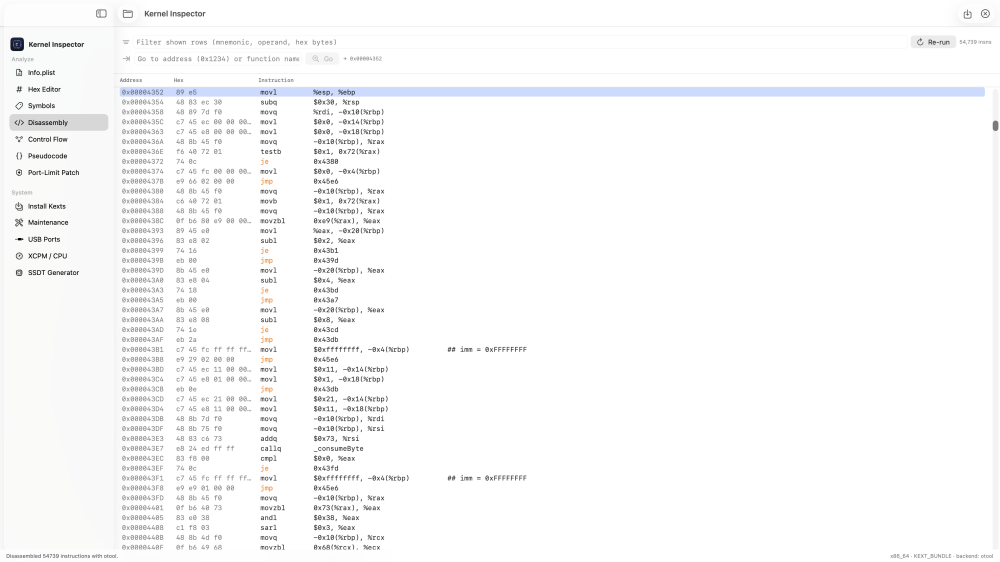
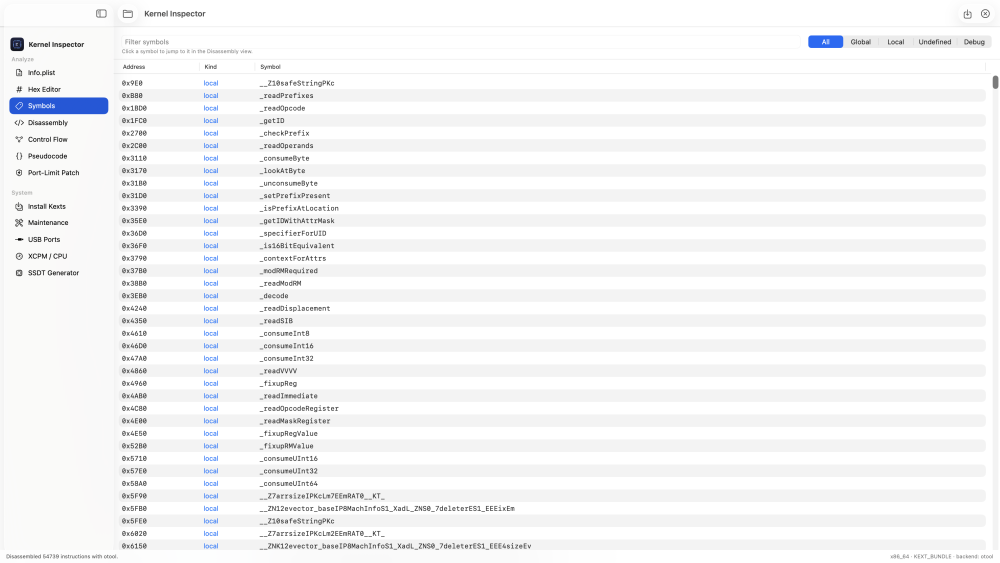
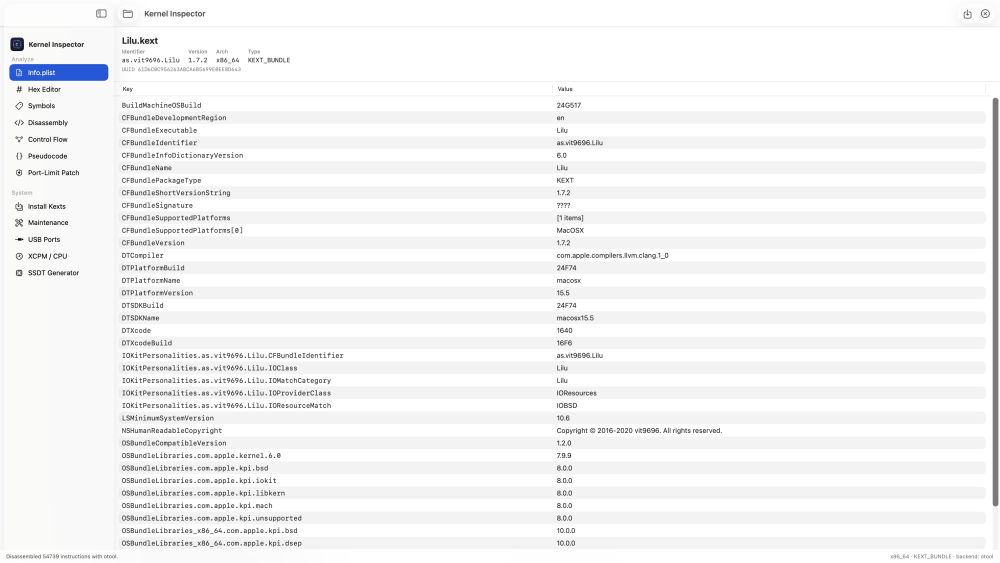
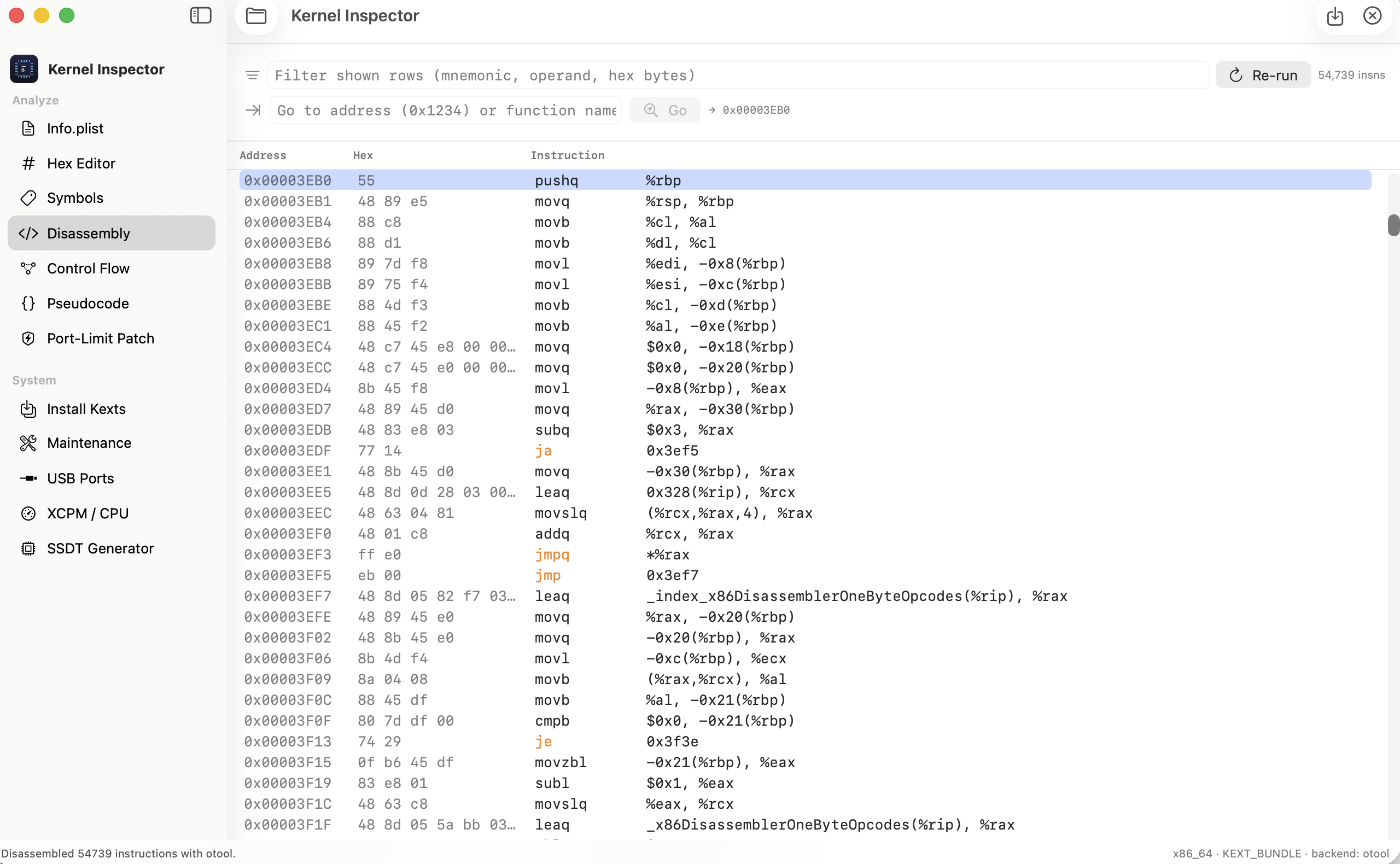
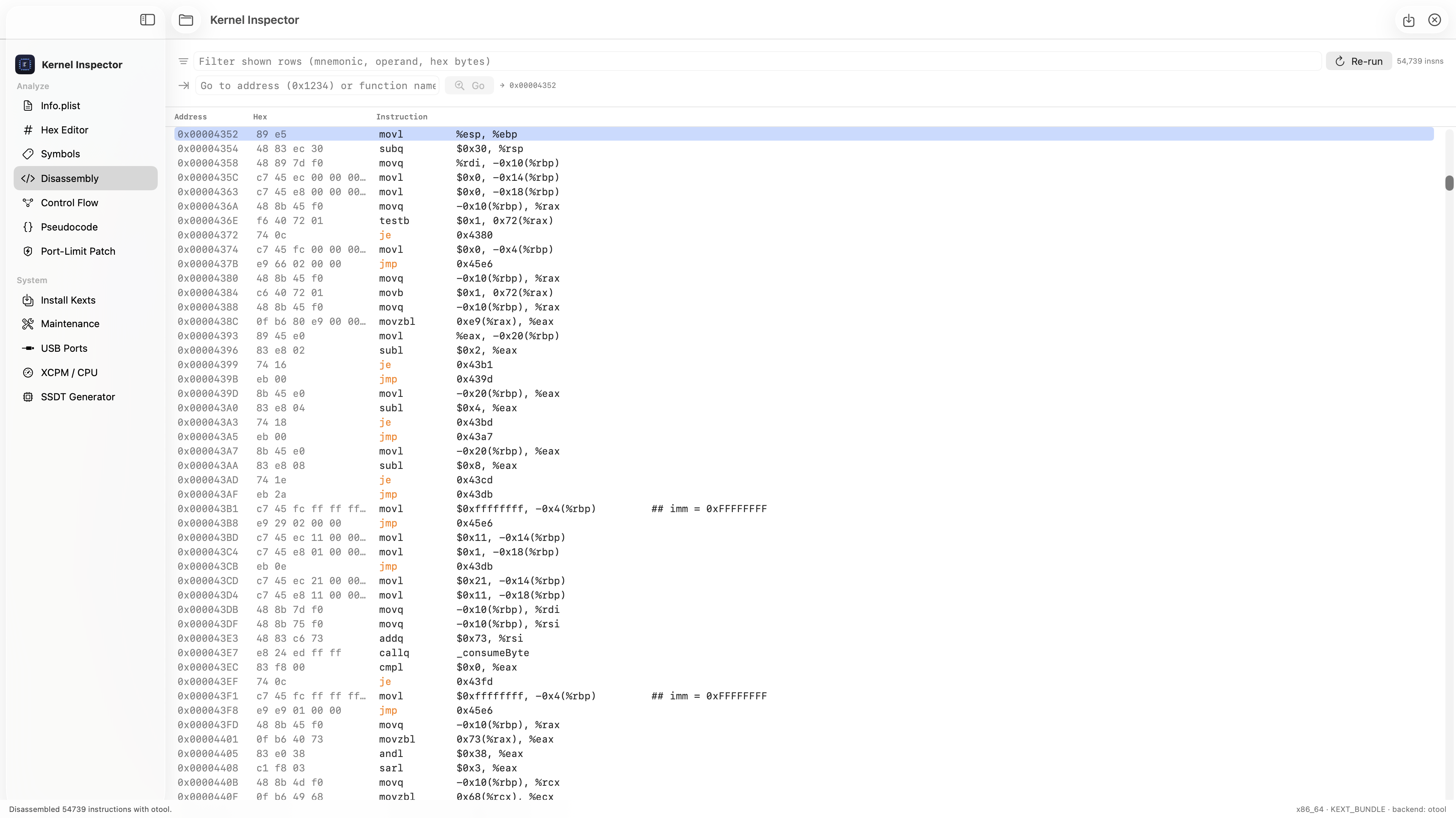
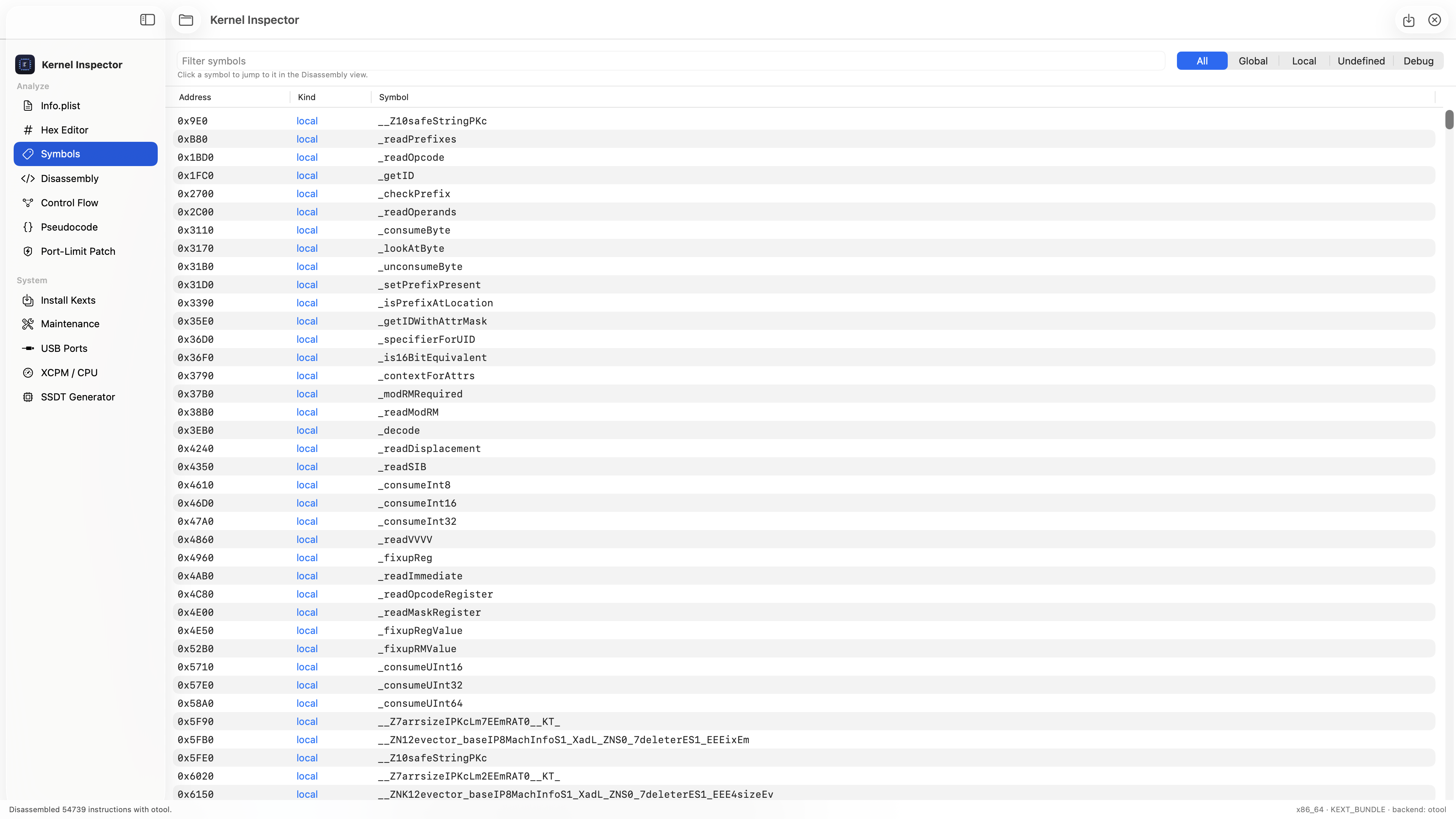
 Good suggestion — I've added this in the latest build. There are now two ways to jump around in the Disassembly view: Go to box — there's a field in the Disassembly toolbar (the one with the ⇥ arrow and a "Go" button). Type a hex address like 0x3EB0 (the 0x is optional) and it jumps straight there. Type a function name instead — e.g. _decode — and it jumps to that function's first instruction. Exact name matches win, otherwise it takes the first partial match. Press Return or ⌘G to trigger it, and it highlights the line it lands on. Click a symbol — open the Symbols tab and just click any function in the list. It switches to Disassembly and jumps right to that function's start. If the exact address falls inside an instruction it snaps to the next one, so a mid-function address still lands somewhere sensible. Let me know if that covers what you were after. https://github.com/luminadevapps/KernelInspector/releases/download/v1.1.1/KernelInspector-1.1.1.dmg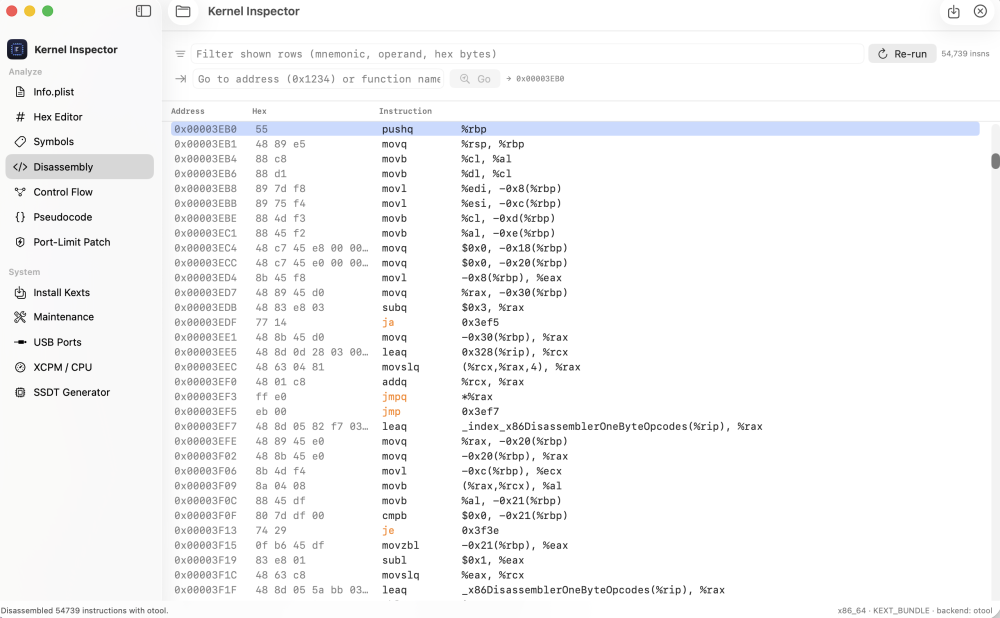
- Yesterday
-
Thanks, but I get the exact same result. Maybe 80GiB for the partition are not enough or the SSD is defective. After the non-functioning install there are only about 10-11 GiB on the APFS container and the rest are free. I keep the log window during the 1st stage install open, but it scrolls by too fast right before rebooting so I don't see what it says. The part about "Syncing extracted files to disk" takes the most time. 🤷♂️
-
Hi my friend ! Maybe tou can try This command : sudo nvram ResetNVRam=1 && sudo reboot
-
 j88tokyo8 changed their profile photo
 -
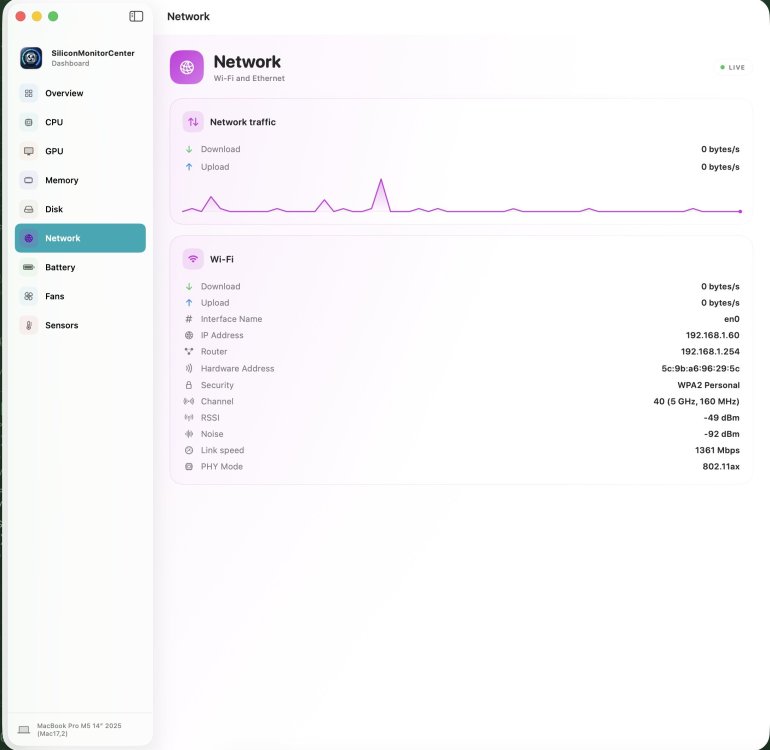
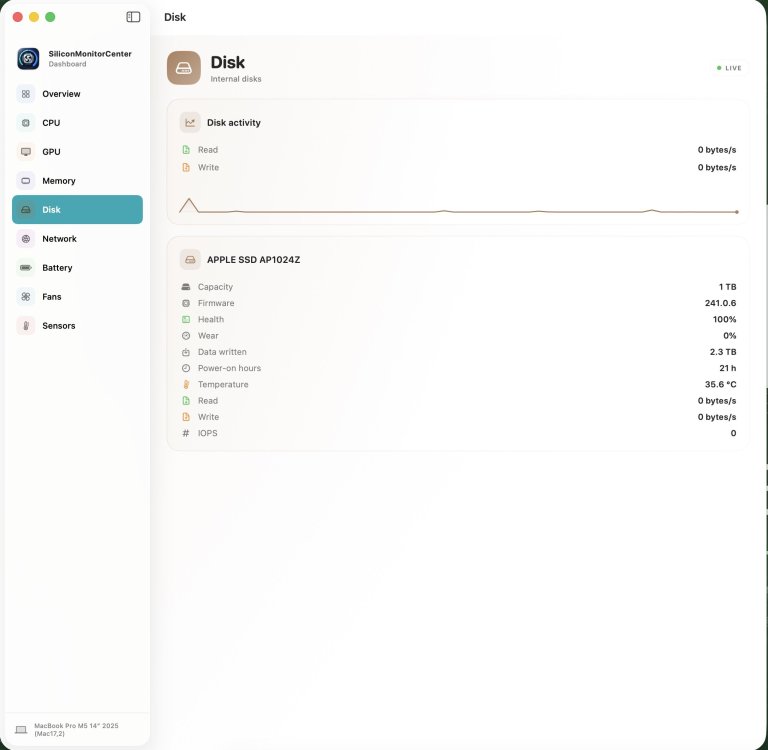
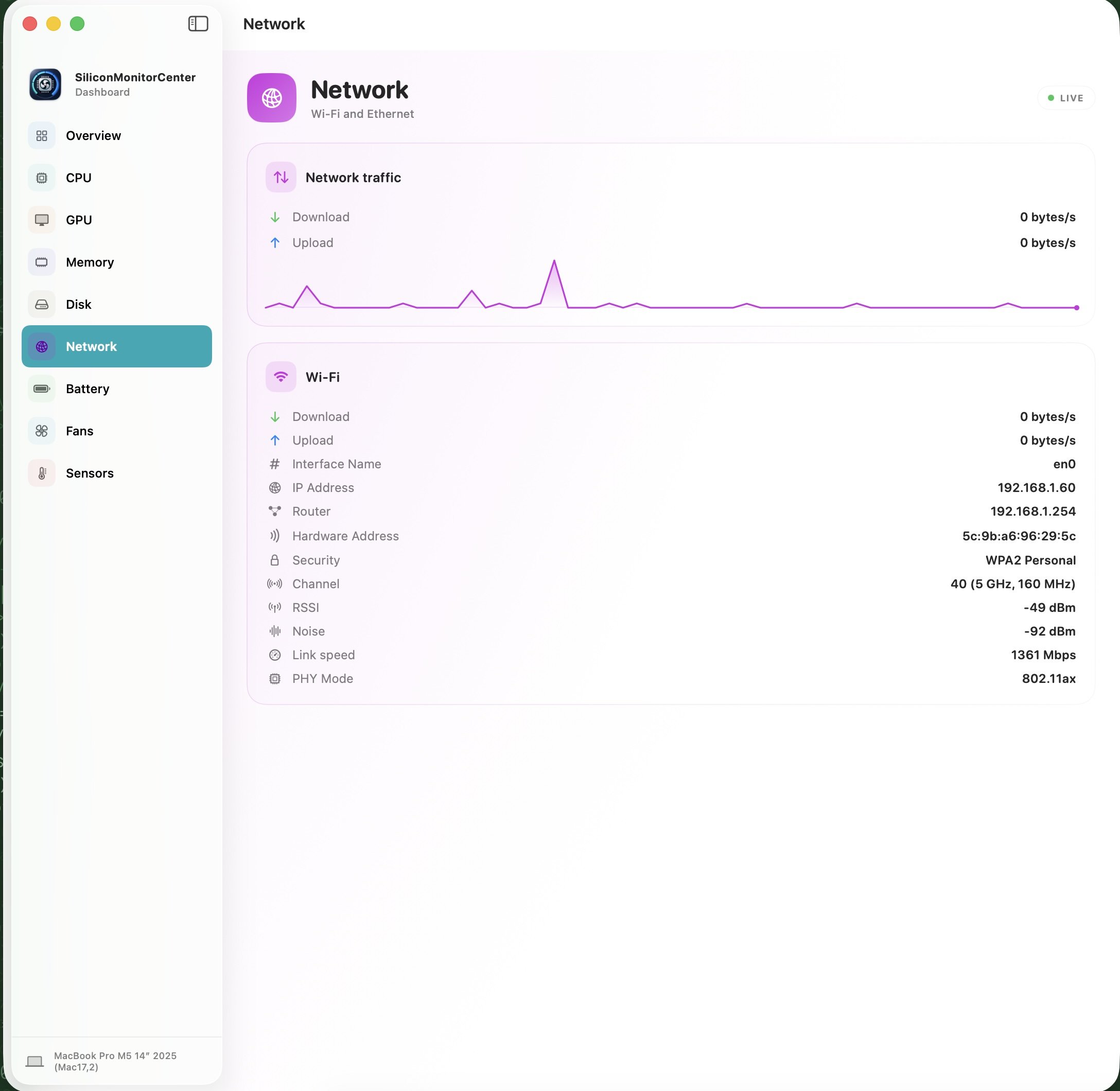
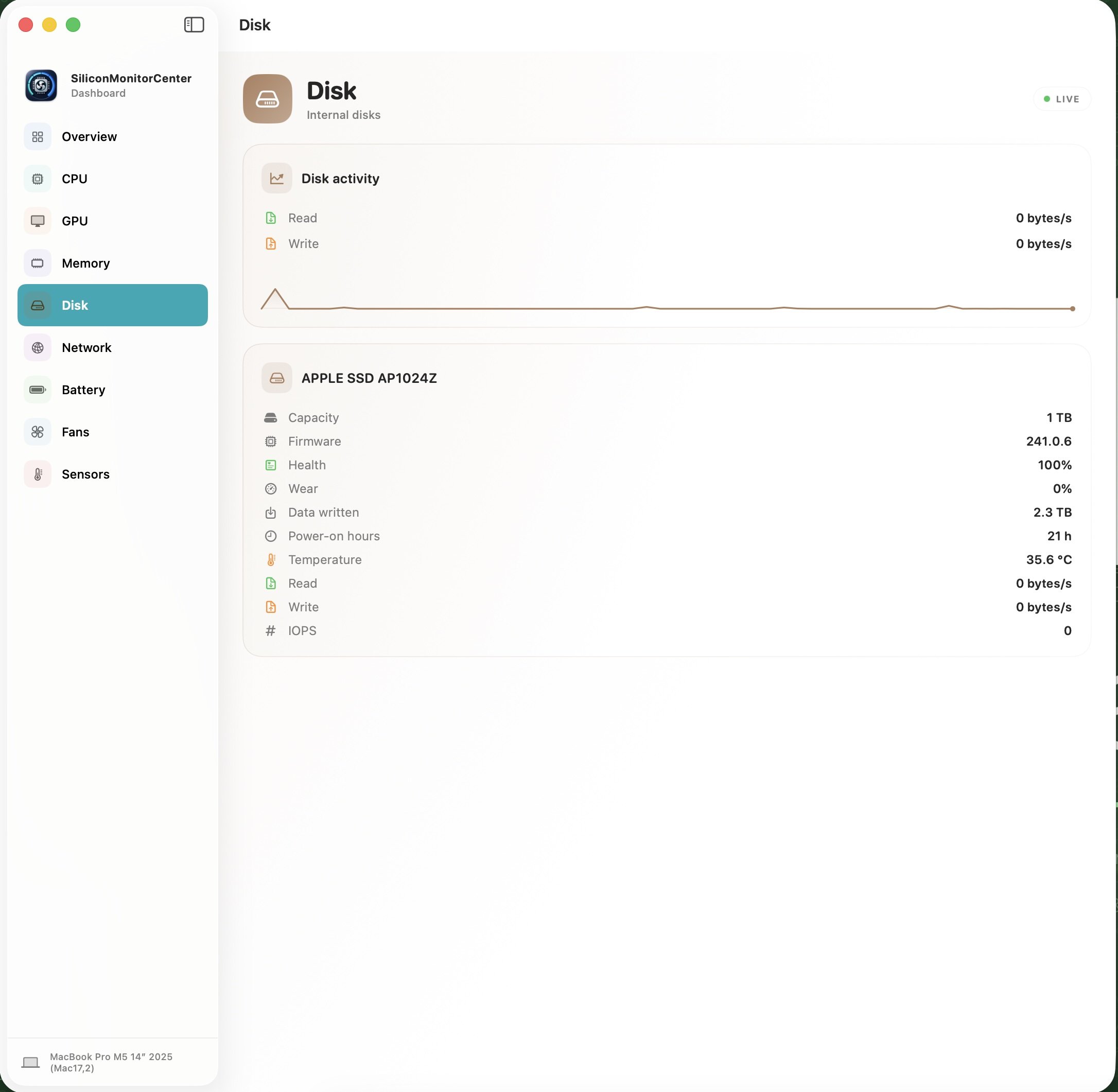
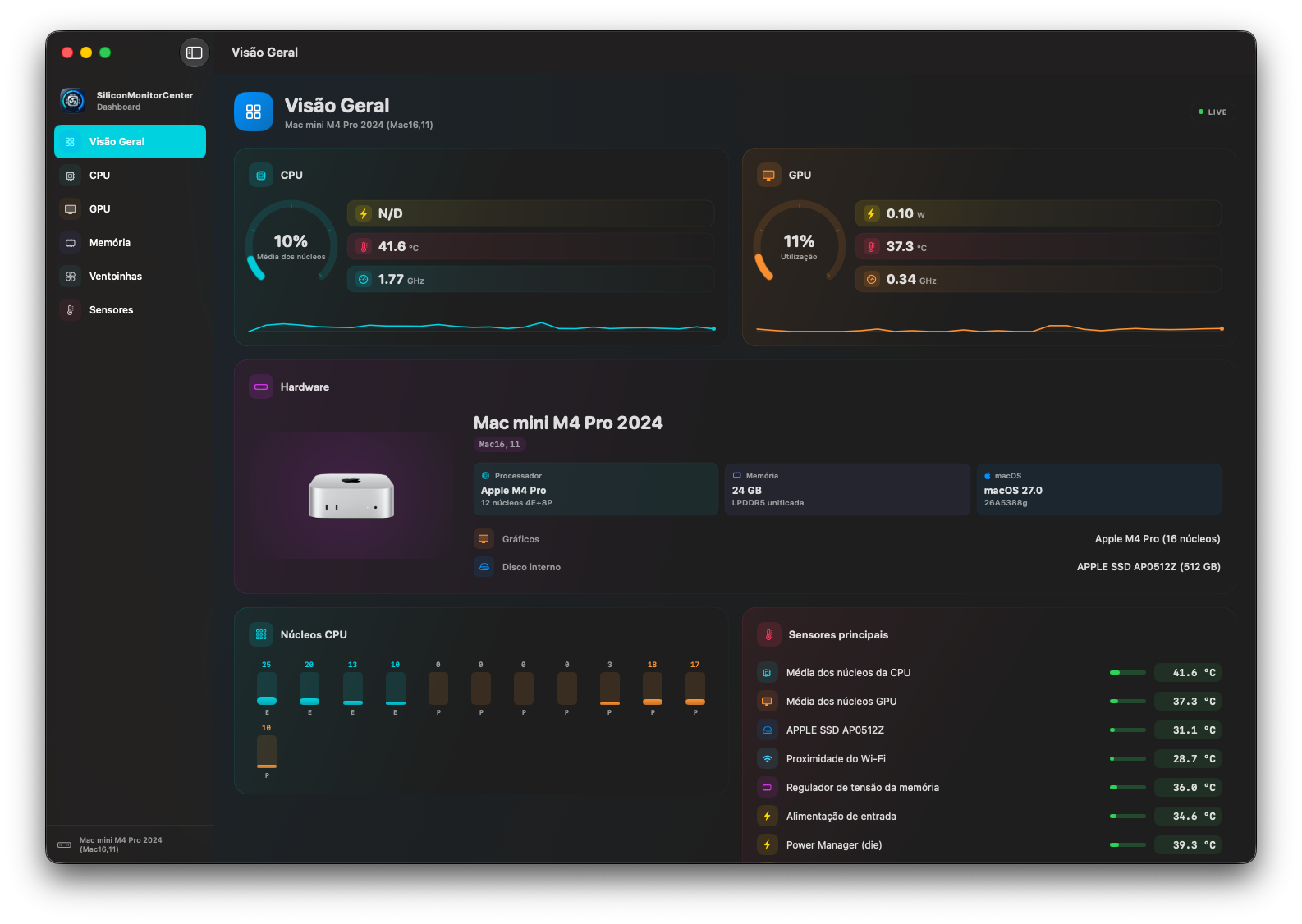
Guys, b10 is ready! I've added two new tabs: disk and network. Give it a try and send me your feedback. https://github.com/Lorys89/App-test/raw/refs/heads/main/SiliconMonitorCenter 1.0 b10.zip
-
@Zenith432 try this https://limewire.com/d/1rH65#lr95NvdDat Direct uploading to the forum isn't working; I had to use an external site.
- 31022 replies
-
- 2
-

-
- bootloader
- efi
- (and 2 more)
-
 Павел Смирнов changed their profile photo
 -
That might be true. Why would you be booting Yosemite on a real Mac with OCLP? I probably misunderstood what you said. If so, my apologies.
-
I noticed something: The volume is set to mute after a reboot, but I still have sound. If I press the mute key the first time, the volume is un-muted in the menu bar icon. After pressing it the second time the mute function is working. Weird. I didn't had this issue in any version of macOS. But it's not so dramatic. @deeveedee Resetting the PRAM on a real Mac with OpenCore Legacy Patcher can be a bit problematic, especcially if you are using a version which is not supported by OCLP.
-
Hi, I'm trying to install Macos Sequoia 15.7.7 with Clover with no luck and am looking for help. CPU i3-10100 H410 Chipset (Gigabyte H410M) Clover 5173 config.plist attached Injected kexts latest FakeSMC, Lilu, WhateverGreen and RealtekRTL8111.kext. Also a couple of Info.plist-only kexts to reassign pci-ids for Sata and Xhci to something Apple supports. Drivers ApfsDriverLoader, OpenRuntime and VBoxHFS. This setup works well with Macos Catalina 10.15.8 (including Apple's update distributed in 2026) The only ACPI patch is something to fix an undefined local variable error in _STA TZ10. I also replace ssdt6 with one to describe USB ports correctly and to effectively do the same as the _STA RTC patch. This patch chooses an RTC device called PNP0B00 instead of "Time and Alarm" Device called ACPI000E that macos doesn't like. No booter, kernel or kext patches are used. The OpenRuntime quirks are as in the config.plist distributed with Clover. I created a USB flash drive installer for Macos15.7.7. It works fine on a Mac Mini 2018, and also boots very well by itself with the above set up with Clover on PC. It boots a lot faster than a Catalina 10.15.7 installer USB. Then I go ahead and try to install Sequoia on an internal Sata SSD. I've tried both "upgrade install" from Catalina AND a fresh install on an empty APFS partition with single empty volume. I encounter the same problem both ways. The first stage of the install that copies files to the system "Data" volume works fine and then concludes with a message to reboot. I reboot. The second stage of the installer goes on for a while, counting down time. Then with about 8 or 9 minutes remaining it reboots. There's no message and I can't tell if this is a normal reboot at the end of the 2nd stage or an erroneous spontaneous reboot. After the reboot the "installed" system is unusable. Clover doesn't show any recognized boot loading option for it (i.e. doesn't find boot.efi or com.apple.Boot.plist in the allowed locations.) Clover does show an option to boot the APFS partition from the "Preboot" volume, but this starts and hangs midway eventually rebooting. When I examine the file systems created from the installer USB with Terminal, it looks like the file system structure on the two System volumes (code+data) was only partially created and is incomplete which why the system is unbootable. And ideas about this or where I can find logs to diagnose it? Thanks. config.plist
- 31022 replies
-
- 1
-
-
- bootloader
- efi
- (and 2 more)
-

Long-time lurker returning – Dell XPS 17 L702X 3D and XPS 9560 owner
Slice replied to Allen Cai's topic in New Users Lounge
I afraid GT555 restricted to 10.11.6 ElCapitan -
I tested. How to go to an address? Or to a function begin?
-
@naquaada Did you try a web search or asking an AI chatbot? There are several reasons that can happen with Yosemite. This is the response from ChatGPT
-
 mega888jom changed their profile photo
 -
 Hi everyone, I'm laobamac. Some of you may know me from my Hackintosh work here — this time I'm sharing something different: Mirage, a native live wallpaper manager and renderer for macOS that I've been building over the past months. macOS still has no real answer to animated wallpapers. The tools that do exist are usually a video player behind a window, and none of them can run the enormous library of content people already own on Windows. Mirage takes the other route: it's a native SwiftUI/AppKit app with three dedicated renderer processes, and it can play scene, web, and video wallpapers — including Wallpaper Engine–style packages straight from the Steam Workshop. It's free and open source (GPL-3.0), Intel and Apple Silicon, no ads, no accounts, no telemetry. Source: https://github.com/laobamac/MirageWallpaper Documentation (CN): https://mirage.simplehac.cn/ Documentation (EN): https://mirage.simplehac.cn/en/ Downloads: https://github.com/laobamac/MirageWallpaper/releases What it does Three wallpaper types, three real renderers Component Tech Job Mirage SwiftUI + AppKit Library, Workshop, settings, process management, macOS integration SceneWallpaper C++20 + Vulkan via MoltenVK scene.pkg / scene.json: materials, particles, LUTs, text, user properties WebWallpaper Objective-C++ + WKWebView HTML/JS wallpapers, media, mouse events, user properties VideoWallpaper Objective-C++ + AVFoundation Looping video, volume, playback rate, fill mode MirageScreenSaver Swift + WebKit/AVFoundation/Metal Standalone live screen saver Renderers are separate processes driven by line-delimited JSON over stdin, so a misbehaving wallpaper can't take the app down with it. Scene playback goes through Vulkan → MoltenVK → Metal, with zero-copy VideoToolbox frame import for video layers inside scenes. Wallpaper library Search, sorting, filters by type/source/tag/content rating, favorites. Import any folder containing a project.json, or drop in an .mp4 / .mov / .m4v and Mirage wraps it into a local wallpaper package for you. Reads wallpapers from the system Steam client, Mirage's own SteamCMD directory, and any custom folders you add. Steam Workshop integration Browse trending / recent / popular / top-rated and tag-filtered Workshop content in-app. Managed SteamCMD install in an isolated directory (it does not touch your real Steam client data), Steam sign-in with Steam Guard (code or mobile confirmation), and a persistent authenticated session instead of re-logging in for every download. Your password is handed to the local SteamCMD process only and is never sent to a third-party server; logs redact secrets. Download queue with real launch/connect/download/validate/complete states and progress. Workshop presets are detected and labelled; if a preset needs a base wallpaper you don't have, Mirage tells you its name and size and asks before pulling it too. Browsing uses the Steam Web API. There's a shared built-in key, but you can drop your own into Settings → General to dodge the shared rate limit. Playback and macOS integration Multi-display coverage, menu-bar controls, launch at login, desktop placeholder image restore. Per-wallpaper volume, playback rate, fill mode, plus whatever custom properties the wallpaper author exposed. Wallpaper Engine–style playlists with per-screen rotation and transitions. Power/behaviour rules: continue, mute, pause, or stop when another app goes fullscreen, when another app plays audio, when the display sleeps, or when you're on battery. Survives the macOS "click the wallpaper to reveal the desktop" interaction and resumes properly. Web wallpapers get a security confirmation before their first run. Live screen saver Mirage ships a standalone MirageScreenSaver.saver you install from Settings → Screen Saver. It plays video, web, and scene wallpapers, keeps your chosen preset and custom properties, and does not require Mirage to be running. Honest status Mirage is early. Video and web wallpapers are in good shape. Scene compatibility is the hard part — it means reimplementing another engine's material, particle, shader, and scripting behaviour — and it's improving steadily, but complex scenes can still look wrong or miss effects. It is not, and may never be, a pixel-perfect clone. But now the rendering engine of Mirage can achieve more than 90% of the scene wallpaper effect, which is perfect enough! And I will continue to update this project in the future. Also worth stating plainly: Mirage is an independent, clean-room implementation. It ships no Wallpaper Engine code or assets, and it doesn't bypass anything — Workshop downloads happen through official SteamCMD under your own Steam account. If something breaks, a GitHub Issue with your macOS version, app version, repro steps, and logs is the fastest way to get it fixed. Reports of specific Workshop items that render incorrectly (with the item link) are especially useful — that's exactly how scene compatibility gets better. Feedback, testing on unusual configurations, and PRs are all very welcome. Thanks for reading. — laobamac
-
- 3
-
-

-
 keonhacai5wstop changed their profile photo
 -
Does anybody know why Yosemite has always volume muted after rebooting? I happens on both Mac and Hackintosh.
-
@LockDown That makes sense. The VoodooHDA.kext 3.6.4 Info.plist includes attribute LSMinimumSystemVersion = 10.13 (macOS High Sierra). If that is accurate and VoodooHDA targets 10.13 and later, then custom builds may be required for macOS versions earlier than High Sierra.

-

[Pre-release] macOS Sequoia 15.7.8
deeveedee replied to deeveedee's topic in New Releases and Updates
@Majonéz The 15.7.8 pre-release versions have problems with some VPNs and firewalls (e.g., Norton's Transparent Proxy is broken). Are you using any 3rd-party VPNs or Firewalls? For Norton's Firewall, toggling Transparent Proxy off and then on again fixes the problem until the next log-on. -
Gmail and Exchange accounts have been broken since the first 15.7.8 build and are still broken in 24G824. They can't be added in Internet Accounts, and Mail won't connect to existing accounts either.
-
 naveen m changed their profile photo
 -
deeveedee changed their profile photo
-
I do custom building to support my unlisted Yosemite
-
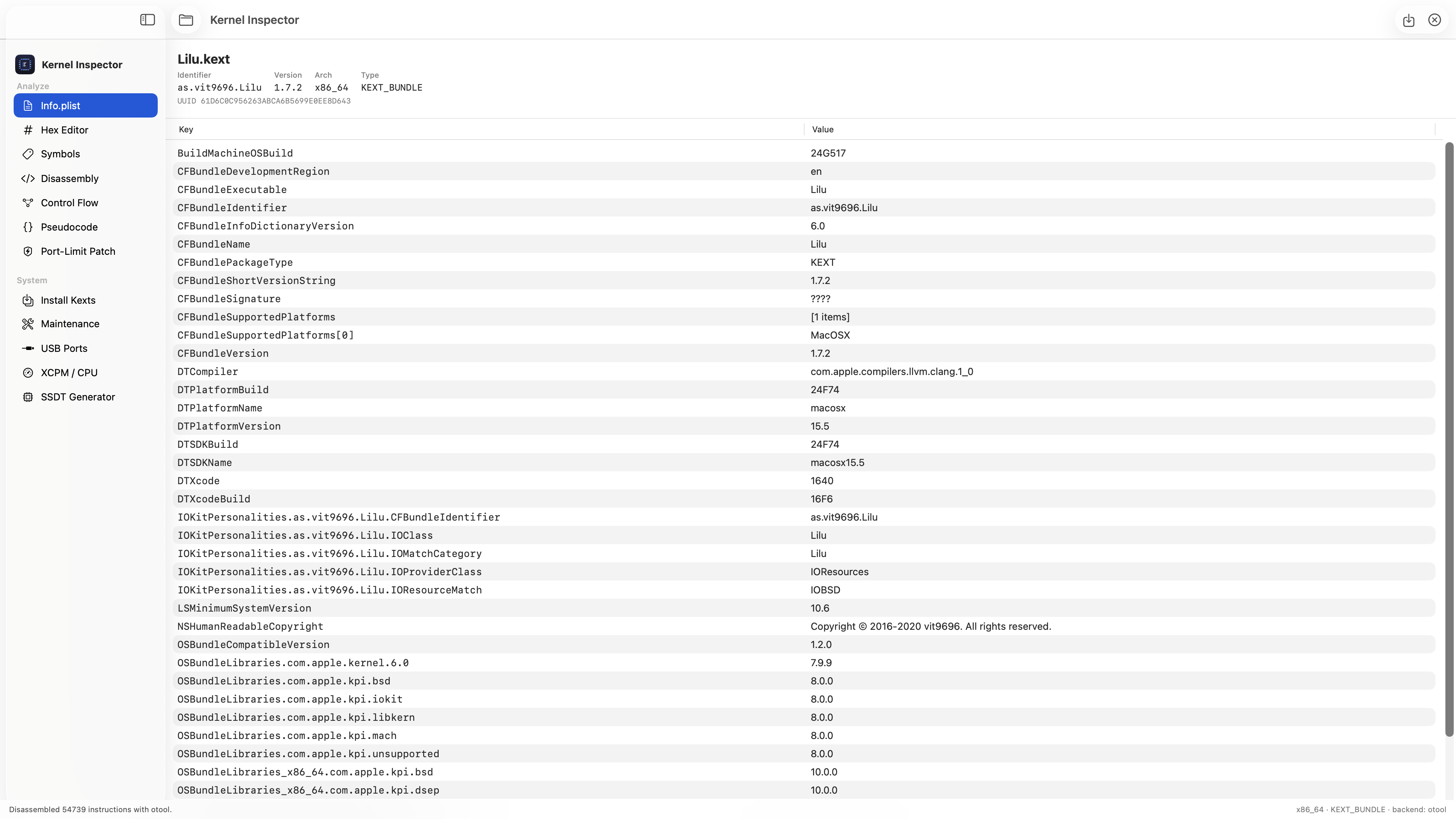
I think no one needs custom building. You have nothing to change except info.plist 364 and 365 have a big difference in 192kHz rate.





.thumb.jpeg.7082d67b3394c9399e80144027a7b397.jpeg)